Life is unfair, George Jones concluded, as he took a cold, hard look at his present circumstances. He was sitting in the cramped office of Mrs. Rossi, the school principal, a space with which he had become well-acquainted during his relatively brief tenure at P.S. 316 Elijah Stroud Elementary School in Crown Heights.
It’s not as if George was a bad kid. Stipulating, of course, that it is in fact possible for a kid to be bad. An ill-behaved kid? Well, that would be a much harder charge to rebut. Not exceptionally ill-behaved, mind you. George simply had a way of getting into trouble the same way so many other eight-year old boys, wherever eight-year old boys can be found, have a way of getting into trouble.
It could be explained by any number of things. Maybe it’s boredom. Maybe it’s an inability to express what they’re truly feeling inside. Some would argue it’s an unfortunate astrological configuration. In many cases, it doesn’t seem to be rooted in anything we can discern. This is not, sadly, one of those cases. For as you’ll soon see, over the course of his young life, George had accumulated quite the list of mostly legitimate grievances.
Where do we even begin? Almost a year ago, George’s father walked out on him and his mother. No warning, no explanation—just gone. That was that. And even though he was never a particularly good dad by most metrics, George still much preferred having a father to not having one at all.
George also had no friends. This is by no means an exaggeration–the boy did not have a single, solitary friend. It is unclear how he found himself in this predicament. He could recall a period of his life when he regularly played with his peers, but these memories grew more and more distant by the day. There’s a phenomenon that’s been observed in large groups of children where certain kids, through unspoken consensus, are deemed beyond the social pale. It’s assumed these decisions must be driven by tangible factors, but such factors, at least for the time being, remain unknowable to the adult world.
It’s probably also worth noting that, according to guidelines issued by the prevailing medical associations in the United States, George could be classified as clinically obese. While our culture continues to make strides toward true body positivity, attitudes were very different not so long ago, as I’m sure many of you can recall.
There are further injustices one could note, but I trust the foregoing evidence is sufficient.
George was lost in thought when the door to Mrs. Rossi’s office swung open. In walked his mother, who, I’m sorry to say, had become almost as familiar with this space as her son. She was still wearing her Postal Uniform regulation parka, issued to all USPS letter carriers. His mother was an exceptionally small woman, and the coat appeared to be a few sizes too big, which gave the impression that she was slowly being consumed by the thing. A humorous image, no doubt, but this somehow only magnified the intensity of her glare.
Mrs. Rossi looked up at George’s mother, who was still holding the door open.
“Hello, Annie.”
George’s mother nodded her head in acknowledgment, but her eyes remained squarely fixed on George.
“You’re still sitting? Let’s go.”
George silently gathered his things and started to walk toward the door.
“Annie, do you have a moment?” asked Mrs. Rossi.
“I’ll call you later, Julia.”
“Annie–”
But George’s mother shut the door, and the two were on their way.
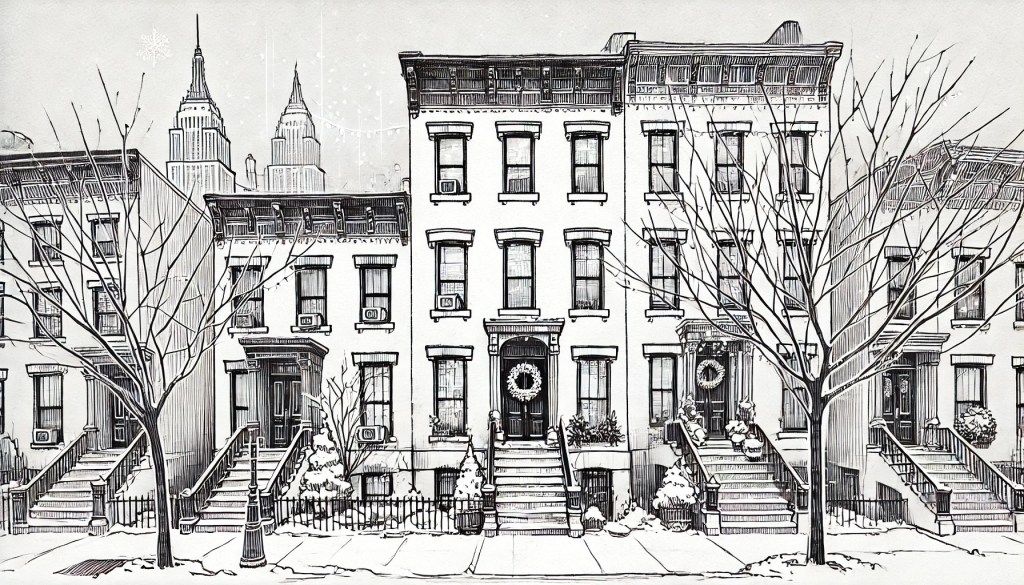
There was less than a week until Christmas. The riots weren’t even a year ago, and the tensions that led to that tragic event had yet to fully subside. But in spite of this, the people of Crown Heights appeared to be in an especially festive mood. The historic brownstones shimmered under the glow of twinkling string lights, while colorful wreaths and garlands adorned doors and windows. Along the sidewalks, evergreen trees stood tall, festooned with dazzling lights, their branches heavy with ornaments that sparkled like stars against the night sky. The holiday spirit was palpable, yet George and his mother seemed immune to its charms as they walked the short distance to their apartment in silence.
George’s mother spoke first. “So, no explanation for today, huh?”
George didn’t respond.
“What, things were going too easy for us? You felt like mixing it up?”
“Life is unfair,” George muttered, his eyes firmly planted to the ground.
His mother turned to him with a look of genuine surprise. “What did you say?”
George looked up and gave his mother a hard stare. “I said life is unfair.”
His mother tilted her head as if to consider this. Words seemed to be on the tip of her tongue, but ultimately, she said nothing. They continued to walk in silence for a moment until George heard a quiet sound coming from his mother’s direction. He turned to look and…was she? Was she really?
Oh yes. Yes, she was. She was laughing, though it was soft, almost to herself, like a quiet release.
“What’s so funny?!” George asked, clearly unamused.
She wiped her eyes and gave him a quiet smile. “Oh Georgie, you’re just now figuring that out?”
What was the use? She couldn’t understand. How could she? How could anyone? How could anyone possibly understand what he was going through?
George trudged along. As he looked up the street, a wave of stress washed over him, knowing he would soon pass by the source of his most pressing anxieties.
And there it was. As always. The Toys R Us on Franklin Avenue. A glorious institution at any time of the year, but its powers were undeniably at their height during the holiday season.
George peered through the store window, where he saw, as he knew he would, the thing. The thing around which all other things revolved. The thing that featured so prominently in his wildest fantasies and most blood curdling nightmares. The Super Nintendo.
The Super Nintendo was the long-awaited successor to the Nintendo Entertainment System, a global phenomenon many credited with saving the US gaming industry in the 1980’s. It was released in the US on August 23, 1991, almost four months to the day.
George still remembered the exact moment the Super Nintendo came into his life. He had been sitting in his school library, thumbing through an issue of Nintendo Power, a magazine dedicated to spreading the gospel of all things Nintendo. That specific issue included a brief preview of the Super Nintendo, complete with glossy photos of the various games set to release alongside the system. Every game looked impressive, but there was one in particular, Super Mario World, that immediately seized hold of his imagination and had yet to loosen its grip.
George was familiar with the previous Mario games. He had thoroughly enjoyed Super Mario Bros 1, 2, and 3 on the Nintendo. But Super Mario World promised to be a categorically different experience. The graphics blew away every other game he’d ever seen. There were way more levels to explore, more secrets to uncover. And now, what was easily the coolest thing of all, Mario could ride around on a dinosaur friend named Yoshi who could fly and eat enemies, among many many other things. It was so amazing, so powerful that George wasn’t convinced any of it was even real. Without hesitating, he ripped the pages out of the magazine and stuffed them into his backpack. Perhaps he felt that without physical evidence of the game’s existence, it would, you know, cease to exist.
That night, alone in bed, George flicked on a flashlight and pored over those torn pages. This became his nightly routine. Night after night, as the months dragged on, he studied every image, every detail. He concocted fantastical scenarios in his head, all of which he had no doubt would be represented in the game.
He imagined soaring through vast, colorful worlds on Yoshi’s back, defeating enemies with ease and uncovering hidden paths no one else could find. He pictured Mario scaling towering mountains, diving into deep oceans, and discovering treasures in places even the game’s creators hadn’t thought of. Super Mario World wasn’t just a game anymore; it was a promise. A promise of escape, of power, of a world where George could be the hero, where everything made sense.
And now it was out. It was finally within his grasp. This was supposed to be the culmination of all his hopes and dreams, the start of a grand adventure. And yet…George abruptly turned away from the store window. He couldn’t bear it. For the game had become no more than a distant mirage, less real than the small collection of images he’d obsessed over.
The two arrived at their home, a small studio apartment nestled within a century-old townhouse. They had moved into the studio not long after George’s father left. When he asked his mother why they were moving into such a cramped space, she told him that their old home was “far too much house for just two people.” Though George had his doubts, in a rare moment of self-restraint, he said nothing.
They quickly settled into their familiar evening routine. George’s mother lit a few candles and turned the radio to an R&B station, letting the low hum of music fill their small space while she made dinner. George sat at his desk, pretending to do homework, but his mind was preoccupied with matters of far greater significance. He couldn’t stop himself from thinking about Super Mario World and the rapidly shrinking possibility it would ever be his.
George had been pleading with his mother for months to get the Super Nintendo. He made what he believed to be a compelling pitch–better graphics, Yoshi, etc.–but she remained unswayed. No matter how many times he rattled off all the reasons he needed it, she made it abundantly clear there was no way she would ever spend hundreds of dollars on what she dismissively referred to as “a toy.”
This left George with only one option. I assume you know where this is going. I am, as you probably guessed, referring to Santa Claus. Old Saint Nick. A reliable friend in Christmases past, somehow managing to always deliver exactly what George had wished for. But this year–well, the writing had been on the wall for quite some time. The fights, the lies, the trouble at school—there was absolutely no way he’d be on the nice list. And this isn’t even getting into the Noodle Incident which…actually, I’m going to stop right here. I think it best that we all move on from that unfortunate affair.
❅❅❅
George was still in a mood the following afternoon as the final bell rang, marking the end of the school day. Everyone else seemed to be in particularly high spirits, it being the last day before the holiday break. George walked through the hallways as the walls echoed with the laughter of his classmates, all of whom would undoubtedly be getting everything they wanted for Christmas.
George wondered if any of them had asked for a Super Nintendo. At least one of them must have, he figured. He wondered how they would all be spending their holidays. Did they have family traditions? Games they liked to play? Foods they liked to eat?
He didn’t enjoy being a pariah. Who would? But he had come to accept that the social order was governed by certain immutable laws. He had no more power to change his status than he could the force of gravity or the pace at which the Earth revolves around the Sun.
I’m aware this is painting an awfully sad picture, but I swear it’s not all bad. There are some good times. Just a few weeks ago, in fact, George was in much higher spirits when he believed he had finally stumbled upon a solution to his Christmas dilemma.
He was lying in bed, staring up at the ceiling, once again going over the relevant facts. His mother was a hard no on the Super Nintendo, so he was left with the Santa option. Santa divides the entirety of kiddom into two categories: naughty and nice. Children who are nice are gifted with Christmas abundance. Children who are naughty, including himself, receive nothing or potentially coal. Some have argued that this is an oversimplification of the system and that additional factors are sometimes taken into consideration, but there is nothing in the literature to support this. Santa, while a fundamentally benevolent figure, abides by a rigid moral code. We must live with the choices we have made.
As mentioned previously, George had known for some time that he was destined for the naughty list. In terms of his behavior that year, his naughty to nice ratio was so lopsided that he could’ve been an angel through Christmas and it wouldn’t have made a difference. It was hopeless. There was nothing he could do to get himself out of this hole. Nothing that immediately came to mind, at least. But what if there actually was a way out? He recounted the facts over and over again, hoping for a breakthrough.
And finally it came. The path forward appeared to him as clear as day. Being regular good for the rest of the year wouldn’t get him anything. But what if he could pull off a deed that was so unambiguously good, so grand, so generous that Santa had no choice but to move him onto the nice list? George’s behavior, though undoubtedly terrible, was terrible in a way that’s familiar to most of us. It was low-stakes. There was nothing that shocked the conscience. If he could do something exceptional, something that showed he was really trying to help his fellow man, this would easily outweigh his fairly commonplace misdeeds. This was just logic, and George believed Santa to be a logical man. Or elf. It’s my understanding there is a divergence of opinion on this point.
So he immediately set out to find a deed that would meet this criteria. He could barely sleep that night–so many ideas were swirling through his head. He would go through just about all of them over the next few days. There were some that were undeniably righteous, such as the plan to raise funding for the nearby children’s hospital, but the work required was clearly beyond his abilities. There were others, such as the plan to draw portraits of everyone in his class, that were doable but far too modest in scope. Each plan was deemed deficient–too demanding, too insulting to Santa’s intelligence, too cliché.
George cycled through plan after plan after plan. Nothing was sticking. None of them seemed good enough. The more he tried, the worse his ideas seemed to get until, finally, there were no ideas at all. He didn’t know what to do. Each day he hoped and he prayed that some new revelation would come to him, but it soon became clear that nothing was on the way. He was done. George had a vision of Santa sitting at a grand desk, quill in hand. Without a moment’s pause, he etched “George Jones” onto the naughty list, flourishes added to each stroke of the pen.
I recall that I started this passage by saying I would share an example of “good times” in George’s life. This was not a good example.
George made his way home. It was a colder than average December afternoon, but the streets of Crown Heights were buzzing with holiday energy. In every direction, people were chattering loudly, lugging carts filled to the brim with the day’s finds. George was suddenly quite hungry, so he headed to Paul’s Grocery just a few blocks away.
Paul’s Grocery was not a grocery, and there are no records of it ever being owned by a person named Paul. Yet none of this seemed to matter to its many customers, so loyal that the store had become a sort of de facto community center over the years. Those inclined to categorization would probably label it a corner store, but in my opinion, this doesn’t really capture its essence. Paul’s was a store for everything from produce to consumer electronics to incense. Its patrons always left with something they were excited about taking home, even if it wasn’t necessarily the thing they came looking for.
Alex, a long-time employee of Paul’s, was smiling to himself, standing at his usual post behind the register. He was, as always, coming correct with his fashion: baggy light blue jeans, a boldly patterned knit sweater, and a navy Kangol hat tilted just so. It was a quintessentially 90’s ensemble, meaning there’s a high likelihood many of you are wearing the exact same thing, depending on the year in which you are reading this.
“King George!” Alex exclaimed as George walked through the door. He straightened up and gave George a formal salute, a barely perceptible grin on his face. George smiled and returned the gesture.
Alex was always a bit of a cypher. He didn’t seem to exist outside of the store’s four walls. Many swore they had spotted him strolling through the Long Meadow in Prospect Park or riding the subway in the wee hours of the morning. None of these accounts could be independently verified. He was unfailingly polite, yet when speaking to him, one had the impression that he was operating on a different plane. It was hard to put into words, really, but it often felt like he was communicating through inside jokes that he never bothered to share with anyone else.
So to most of the Paul’s community, Alex was a somewhat polarizing figure. To George, however, Alex was the second best person in the world, right after his mom. This was despite the fact that George could understand no more than 40% of what Alex was saying at any given moment.
Alex watched George study the candy bar shelf, carefully weighing his options.
“So many choices. Such is life. Trade-offs are inevitable. But perhaps the path you end up choosing is the only path you could have chosen.”
See what I mean?
George grabbed a Twix and walked up to the counter. Alex leaned in slightly. “So,” he asked, adopting the posture of a hard-hitting news interviewer, “how are you faring this holiday season?”
George looked down and shrugged.
“You’re dodging the question, Prime Minister!” Alex shouted in a faux English accent. More light jabs seemed to be on the way, but something in George’s eyes made Alex reconsider.
“Well,” he asked in a more sincere tone, “what do you want for Christmas?”
George wasn’t sure what to say. He couldn’t dare tell the truth, as he was pretty sure he would start crying, and crying in front of Alex was a literal nightmare. But pretending he wanted a different, inferior gift felt like a betrayal.
“I’m not sure. It doesn’t really matter.”
Alex studied George closely. Alex never looked sad–never–but there was an undeniably melancholic quality to his expression.
“I saw you eyeing that Snickers over there,” Alex said. “Go ahead and grab one of those, too. On me.”
As George made his way back to the candy, an older gentleman walked into the store.
“Mr. Wu, as I live and breathe,” Alex said with a slight bow.
“Alex,” Mr. Wu replied flatly, as he pulled a folded list from his coat pocket and headed toward the far end of the store.
“No time for pleasantries today, Mr. Wu?”
Mr. Wu didn’t answer, the quiet rustle of his list the only response.
George glanced toward the older man, watching as he rummaged through the shelves. Mr. Wu wore a long charcoal overcoat, a gray scarf knotted neatly at his neck, and horn-rimmed glasses perched high on his nose. On his head sat, as always, a weathered brown fedora that George imagined might be even older than Mr. Wu himself.
Mr. Wu lived alone in an apartment just down the hall from George and his mother, and though they often crossed paths, their interactions had been limited to brief, polite greetings. George was pretty sure that Mr. Wu preferred it this way. He was never rude, exactly, and yet George just couldn’t shake the feeling that Mr. Wu didn’t like him.
Mr. Wu scanned the shelves with a weary expression.
“Alex,” Mr. Wu called without looking up, “you wouldn’t happen to have those fresh noodles today, would you?”
Alex leaned on the counter and chuckled. “Mr. Wu, you know I love you, but we’re a long ways from Chinatown.”
Mr. Wu grunted, folding his list back into his coat. “I figured as much.”
“This is for that, uh… what’s it called? Zah…”
“Zha jiang mian,” Mr. Wu said, a hint of sadness in his voice.
“You could just order takeout,” Alex offered casually.
Mr. Wu shot him an irritated glance. “It’s not the same.”
George’s heart began to flutter. He didn’t quite know what was going on, but he understood that this was a moment of great importance.
“I see, I see. What are your Christmas plans, Mr. Wu?” Alex asked.
“I’ll be at home.”
“I see, I see. Any of your kids coming home this year?”
“No.”
Alex gave a slow nod. “In that case, I wish you well on your solo journey. May this be a Christmas of introspection.”
Mr. Wu glanced down for a moment, then offered a brief smile—polite but distant. “Okay. Goodbye, Alex,” he said as he shuffled toward the door.
The bell jingled as the door closed behind him.
George’s heart was practically leaping out of his chest. The enormity of the situation was almost too much to bear. He was on the verge of a major revelation. He knew it! Think, George! Think!
He replayed the preceding events in his head over and over again. Mr Wu…Christmas…zha jiang mian…what could it all mean? Is it? Oh, I see. Yes, of course!
George dashed to the door, almost tripping in his excitement. “Bye, Alex!” he called out, as he threw open the door and dashed in the direction of his apartment.
Alex watched him go.
“Tread carefully, child.”
Within minutes, George was at his desk, frantically writing out his master plan, careful not to miss a single detail. His handwriting, never great, was basically illegible. His attempt at spelling zha jiang mian was even worse than you’re imagining. But what did that matter? What mattered was the plan, and the plan was flawless.
The lonely widower resigned to spending Christmas on his own. The boy who cooks the old man a dish so good, so full of care, that it reminds him of better times. Reminds him that in this often lonely world, we are still capable of connection. Still capable of love.
How could Santa resist this? How could Santa, in good conscience, deny George a place on the nice list after he pulls off a deed so pure of heart, so honorable?
George’s mother had the TV turned to the local news. As a rule, George tuned that kind of stuff out, but his ears perked up at the mention of the Super Nintendo.
According to the news anchor, the Super Nintendo had become quite the hot ticket item that holiday season. Stores everywhere were completely sold out, and desperate parents were turning to scalpers selling the console for exorbitant prices.
George’s mother shifted in her seat. “You see this, Georgie?”
He nodded. After watching the segment for a little while, he turned back to his desk and continued to flesh out his scheme.
“And you’re not worried?”
George briefly considered the question, then shrugged. “I’m sure Santa has what he needs.”
George’s mother adjusted her position again. “You don’t think Santa’s affected by this?”
Though she was doing a mostly good job of hiding her irritation, it was clear that her mood had changed.
George stayed silent. He knew when his mother was trying to get a point across, and he wanted to understand what that point was, but he didn’t know what to make of this. What did Annie Jones know of the North Pole’s inner workings? Was she suggesting that supply issues in the New York City video game market were in some way connected to Santa’s production capabilities? That this was a situation with no precedent? George knew that wasn’t true. It couldn’t be.
He returned to his work.
❅❅❅
When George’s mother left for her route the next morning, he immediately set his plan into motion. Step 1: Get to Chinatown. Based on yesterday’s conversation between Alex and Mr. Wu, this was the most likely place to find the ingredients for zha jiang mian.
Well, technically, getting to Chinatown would be Step 2. Step 1 took place about an hour ago, when George slipped a $20 bill from his mother’s wallet while she was getting ready in the bathroom. Believe it or not, this was the first time he’d ever stolen from his mother. It was one of the few lines he thought he’d never cross. He felt bad, sure, but what else could he do? He needed money to pull off this plan, and this was the only way for him to get it. There was a whole Christmas at stake here. This was not the time to get sentimental.
Mere minutes later, George approached the Eastern Parkway subway station. He carried a pocket subway map that he had already studied over and over, tracing the routes with his finger until he knew exactly what lines would take him to Chinatown. But when he reached the top of the stairs leading down into the station, he hesitated. He had ridden the subway more times than he could count, but always with his mother. This would be his first time ever doing it on his own. What if he got lost? What if someone tried to kidnap him? His heart thudded in his chest. He was scared, and he knew that he was right to be.
George stood frozen at the entrance for what felt like an eternity. Crowds of people rushing in and out of the station squeezed past him, visibly annoyed by his indecision.
He had a vision of Yoshi’s Island. Yoshis of all colors—green, blue, red, yellow—were being mounted by far braver boys and girls. Boys and girls who were not afraid to ride the subway by themselves. Who walk down those stairs with no thought to the consequences. He took a deep breath. And then another. And then he walked into the station.
Thankfully, George’s ride to Chinatown was uneventful. Those of you who live in New York City–or even just visited–are likely familiar with the city’s unofficial motto: mind your business. An eight-year old riding the subway on his own probably doesn’t rank among the weirdest things you’ve seen that day.
As George stepped out of the Canal Street station and into Chinatown, it was like entering into a different world. The air smelled unfamiliar—a swirling mix of fried dumplings, fresh fish, and something he couldn’t place, both sweet and sour. The sidewalks were packed with people: shopkeepers hawking fruits and vegetables George had never seen before, tourists fumbling with cameras and maps, and elders bent over games of chance, slapping cards down with the conviction of the committed gambler. Conversations hummed around him, most of them in languages he didn’t understand, a blend of Mandarin, Cantonese, and English.
The signs above the storefronts were a riot of color—reds and golds, bright neon tubes buzzing faintly against the gray sky. Some had English translations, but others looked like secret codes written just for the people who lived here. George felt especially tiny in this place, as if the streets themselves curved in ways that made no sense, with narrow alleyways appearing suddenly between the buildings, inviting him in but also warning him not to wander too far.
He clutched his pocket map tighter. “Just get the ingredients,” George whispered to himself. He continued down Canal Street until he came to a store that was even busier than the rest. He couldn’t read the storefront sign, but the steady stream of people emerging from the entrance–each carrying a bag filled to the brim with food–assured him he had found the right place.
No sooner did he step into the store did he come to the unfortunate realization that he had no idea what zha jiang mian was. He knew Mr. Wu had asked Alex for fresh noodles, but what were the other ingredients? Would they all be here? Would $20 be enough? A whole host of worst-case scenarios swirled through his brain.
George tapped the shoulder of a store employee who was busy putting products on the shelves. She turned around with an annoyed expression but quickly smiled once she realized it was only a kid. She looked at George, waiting for him to speak.
“Um…zha jiang mian?”
The employee continued to look at him.
“Zha jiang mian?” he repeated.
The employee, clearly confused, responded in Mandarin.
There was an older woman–a customer–who witnessed this interaction. She walked up to George and grabbed him by the hand. Under normal circumstances, this would have been a terrifying development. The children of the early 90s were no less familiar with the concept of stranger danger. However, there was something about this woman that put George at ease. He couldn’t say why she was holding his hand, but he knew that she meant him no harm.
Still holding onto him, the woman grabbed a basket, then walked George up and down the aisles, grabbing ingredients as they went–noodles, ground pork, scallions. She moved with confidence, with a dancer’s grace, gliding from item to item as if on a predetermined path. George was simply along for the ride, more than happy to let her take the lead.
They ended up in the sauces aisle, where the woman grabbed a bottle of soy sauce and placed it in the basket. She took a few steps down the aisle, then abruptly stopped. Something was wrong. She shook her head and walked up and down the aisle, once, twice, muttering to herself while scanning every inch of the shelves.
A girl of about 15 strolled past. The woman called out to her in Mandarin, sparking a brief conversation. While George couldn’t understand their words, he did pick up that the woman was very surprised by what she was hearing. When the conversation came to an end, the woman gestured toward George.
The girl turned to him and said that the store was out of fermented soybean paste, which, she explained, was the final ingredient he needed for the dish. Apparently, they’d been out of it for quite some time, a distressing state of affairs for many of their customers. She suggested that George try his luck at one of the nearby stores.
The older woman handed George the basket, smiled warmly, then glided to another area of the store.
George paid for his goods, then went to a nearby store to find the final ingredient. They didn’t have it. So he tried another store. No luck there either. According to one of the store employees, this soybean paste shortage seemed to be affecting the entire neighborhood.
He looked up at the sky. The sun would be setting soon. He wanted to keep looking, but his mother must have been finishing up her route by now, and if she found out he went all the way to Manhattan on his own, he’d be grounded for the rest of time. For generations, schoolyard tales would be told of his eternal imprisonment. No, he needed to get home now. He sprinted to the subway and made his way back to Brooklyn.
You might expect George to be feeling disappointed in this moment, but wouldn’t you know—the boy was in exceedingly high spirits. It was December 21st. He still had all of the 22nd, 23rd, and 24th—three whole days—to find the soybean paste and cook the dish for Mr. Wu. It was all coming together. The mysterious forces of Christmas appeared to be on his side.
❅❅❅
The next morning, George woke up feeling lighter than he had in months. He was so close to pulling off his plan, and he had more than enough time to do it. He jumped to his feet, practically bouncing across the room as he got dressed.
His mother was making scrambled eggs in the kitchen, her USPS uniform already on. She yawned as she seasoned the eggs in the pan.
“Good morning, baby,” she said without looking up.
“Good morning, mom!” George’s voice was bright, almost musical.
She turned, surprised by his cheerfulness. It’s not that George was a grumpy kid. It’s just that over the past year, mornings with him had been more…quiet. Nothing really seemed to excite him. But today, for some reason, he was glowing.
“Look at you,” she said with a smile. “What’s got you in such a good mood?”
George laughed—a quick, bubbling laugh he couldn’t hold back. He shook his head and opened the fridge, hunting for milk. “Nothing!” he said through giggles.
His mother raised an eyebrow, but she couldn’t help but laugh along with him. Her heart swelled seeing her son like this, so joyful and carefree. She needed this. She needed a really nice moment before what she knew would be a long and stressful day of work.
There was a lot she liked about working for the postal service. She enjoyed serving her community. She liked learning new routes, knowing she was becoming a fixture in the lives of so many. But it wasn’t an easy job. She was on her feet for hours, lugging heavy bags of mail around. And it was so cold this December. And it wasn’t making her enough money to give George the life that she wanted him to have. Most days, she left for work already consumed by her various worries.
But not today. George’s joy was infectious. She rubbed his shoulders as he poured some Honey Nut Cheerios into a bowl.
“You’re in some kinda mood, huh?” she asked with a smirk.
He grinned, then ate a big spoonful of cereal.
“Well, whatever it is, I’m glad.”
Just a few minutes after George’s mother left for work, George was back on the streets. The first stop was, obviously, Paul’s Grocery. A sly smile crept onto Alex’s face when George asked for the ingredient. He was always up for a good scheme, and he had a strong suspicion that one was in the works.
“What you got going on?”
George stayed silent. He had resolved to not tell anyone about his plan, lest it be jinxed.
“You know,” Alex said, “when I was growing up in Haiti, we had a saying about people who keep secrets.” Alex’s origins seemed to change on a weekly basis. George could have sworn it was Trinidad as recently as last week.
Well, whatever it is you have planned, you know I’d love to help you,” he continued, “but we’re all out of soybean paste. Don’t think we’ve ever had it, really.”
George was disappointed if not entirely surprised.
“Don’t you worry, my boy. Your mom ever take you to Food Palace around the corner?”
George nodded.
“I know the owner, Mrs. Snyder. Know her quite well, as a matter of fact. She’s a woman of honor. I am sure she will help you on your quest.”
George would soon confirm that the good people of Food Palace were, indeed, honorable. But they did not have any soybean paste. Neither did the equally good people of ABC Market a few blocks away.
George continued his search. He would find what he was looking for. He was certain of it. And yet his visions of Yoshi’s Island, so vivid when he woke up that morning, were growing foggier by the minute.
The next store didn’t have it. Neither did the one after that. He exhausted the grocery stores fairly quickly. Next were the bodegas. Thrift shops. Pharmacies. Pet stores. All gave him the same answer. He went to one final establishment, a specialty hardware store that mostly sold power tools. You probably aren’t surprised to hear that this store did not carry any food, let alone a Chinese bean paste that had apparently become quite the coveted item this holiday season.
It was getting late. George knew his mother would be home soon, so he started to make his way back. He found he was having a hard time looking at all the Christmas lights. He would try again tomorrow morning, but he knew there was no point. What a joke. He wondered why he had ever believed things could turn out differently.
The next day—the 23rd—went as expected. Nowhere had it. There was nothing left to be done. George walked through the neighborhood, no real destination in mind. What’s curious is that he didn’t really feel upset at that moment. This was simply a reversion to the mean. An inevitability. The whole year had been crummy. Why would Christmas be any different?
He found himself in front of the Toys R Us. He looked through that familiar window, fully expecting the tears to come, but then…nothing. Nothing at all. No sadness. No resignation. Nothing.
The front door opened, and a man and a boy about the same age as him walked out together. The boy was carrying a Super Nintendo, his face locked in an expression of pure joy. Beside him, the man, who George assumed was the boy’s father, just seemed happy to be there for a moment he knew his son would remember forever. They both looked so cheerful. So content. It was too much for George to bear.
Why does this boy get a Super Nintendo and not George? He clearly has a dad. He probably has friends. Why does he need this, too? Why does this boy get everything and George gets nothing? Was George a bad person? He must be a bad person. It’s the only explanation that made sense. Why else would his dad leave? Why else would he get in trouble all the time? Why else would all the things that have happened to him happen to him?
He continued to walk, equipped with a new understanding of his true nature. There was something empowering about this realization. Already, it was transforming his view of the world and the place that he occupied within it.
There was something pulling him in the direction of Paul’s Grocery. He remembered that Paul’s was where he first came up with the idea for the plan. Now that it was dead, perhaps he was being called in to pay his respects. He couldn’t say for sure. He just knew he needed to be there.
Alex had his nose buried in a paperback when George walked into the store. As always, his face lit up when he saw the boy.
“King George! Did you find what you were looking for?”
George confirmed that he did not.
“I’m sorry to hear that.” His tone shifted slightly, softening. “You know if you ever need anything, I’ve got you, right?”
George nodded.
“You’re my brother. You got that?”
George nodded again.
“Good. Good.” Alex grinned and gave George’s shoulder a quick squeeze.
The store’s phone rang. Alex picked it up and then launched into a fast, animated conversation in a language that George couldn’t identify. Maybe German? After a few minutes, Alex hung up and turned to George.
“I’ve gotta step out for a second,” he said, slipping on his parka. “Would you mind standing watch until I return? Thieves abound.” He winked, then quickly exited the store.
George looked around. He sighed when he realized he was the only person in the store. Of course it had to be this way. He loved Alex. He loved him so much, but of course it had to be this way.
He stepped behind the counter. For a moment, he just stared at the register, the little bell at the top of the cash drawer catching the light. But then he remembered who he was. He opened the drawer, stuffed two big handfuls of dollar bills into his backpack, and bolted out the door.
George ran and ran and ran. His lungs were on fire, and his legs wobbled like jello, but he would not stop until he’d reached his destination. He’d done what he’d done, and he knew that if he stopped to think about it for even a moment, the psychological consequences might prove disastrous.
This forward momentum powered him all the way through the automatic doors of the Franklin Avenue Toys R Us. He finally paused to allow himself to catch his breath before taking in his surroundings.
Chaos reigned. Bright yellow sale signs hung overhead, clashing with the neon pink and green packaging of board games towered on shelves. The aisles were packed—exhausted parents pushed carts stacked high with puzzles, race cars, and baby dolls. Wild-eyed children in puffy winter coats zig-zagged through the crowd, hands clutching action figures and plush toys. Anyone else would have been overwhelmed by this display. But not George. Not today. For he had come much too far to let anything distract him from his mission.
After waiting in line for what seemed like forever, George finally found himself in front of an exhausted cashier. The cashier looked to George’s left, then his right, before, with a sigh, he resigned himself to the current situation. He was in no mood to deal with a little boy’s tomfoolery, but what choice did he have?
“Can I help you?” he asked.
“I’d like one Super Nintendo.”
The cashier shook his head in disbelief.
“Please?” George added.
“So you’re coming here, parentless, two days before Christmas, asking for the most popular toy of the year? The same toy that no one can find anywhere? Is that—“
George pulled two fistfuls of crumpled cash out of his backpack and plopped them onto the counter.
The cashier’s eyes moved down to the pile of money, then back up to George. There was something about the nerve, the sheer impudence of it all, that he found amusing.
“As it turns out,” he said, chuckling to himself, “you are in luck.” He crouched down behind the counter, then straightened up, Super Nintendo box in hand.
“Someone just returned this. It’s the last one we have.”
George did not respond to this.
The smile faded from the cashier’s face. He regarded George more seriously, suddenly aware that he may not have been treating this moment with the gravity it deserved.
“Well,” he said, as he solemnly handed the bag over to George, “you must have been very good this year.”
When George reached home, it was almost time for dinner. As he was about to head into the apartment, he heard the sound of his mother’s voice cut through the thin door. He could tell that she was on the phone. He could also tell that this was not a pleasant interaction. George put his ear to the door and listened closely.
“You’re saying you have one now?” his mother asked. He could hear the tension in her voice. “Uh huh…and how much?”
Though George couldn’t hear what the other person said, his mother’s reaction suggested that whatever it was she was trying to buy, she was not being offered a fair price for it.
“You’ve got to be kidding me!” his mother shouted. “No way! Who has that much money?”
There was a brief moment of silence and then his mother spoke again. “No, no, hold it for me. Al, you’ve gotta hold it for me. I’ll figure something out. Yes, I’m on my way.”
Before George could slide his key into the lock, the door opened, and his mother burst out so fast that she almost ran him over.
“Oh, hi, Georgie!” She knelt and gave him a kiss on the cheek. As she headed down the stairs, she explained that she needed to step out for a bit and would be back soon.
George sat down on a couch that faced the TV. He took the Super Nintendo box out of his backpack and slowly rotated it, making sure to study all of its different sides. He had assumed he wouldn’t be able to play Super Mario World until Christmas Day. He knew that if his mother saw the system now, she would wonder how he got it, and she would correctly assume it had been acquired through illegitimate means. He would be forced to return it, and all of this would have been for naught. So, yes, George was aware of the risks, but I’m sure you know that this didn’t stop him. He was thinking about everything he’d been through to get there, the choices he had made. And now that he finally has the thing, he’s supposed to stop?
He unboxed the system and, after connecting it to the TV with little difficulty, turned the dial to channel 3. Then he inserted the Super Mario World cartridge. Right as he was about to turn the system on, he paused. He took a few seconds to reflect on the significance of the moment. Admittedly, these were not the circumstances he had envisioned.
He turned on the system. There it was–Super Mario World. As soon as he saw the title screen, he knew that the game would be every bit as glorious as he’d imagined. The first level was only further confirmation of this. It was gorgeous, with amazing level design that encouraged exploration and a playful soundtrack that heightened the sense of adventure. He saw this. Knew it to be true. Yet something was off. There was something about this that didn’t feel right.
He moved on to the second level, which was somehow even better than the first. Yoshi made his first appearance, and he definitely lived up to the hype. It was all very good. But just good. It was not transcendent. He was not finding himself lost in another world. He was still very much here, and he could not stop thinking about what had happened that day. He remembered Alex calling him his brother. He remembered stealing the money.
George started the third level, but he could barely focus. His timing was off, so he kept missing platforms and falling into endless pits. After dying for the fifth time in a row, he decided he’d had enough. He packed up the system and hid it in one of his drawers. Then he turned off the lights and lay in his bed, unable to fall asleep. When his mother eventually came home, the sadness emanating from her was so powerful that it made George shiver. Without turning on the lights, she kissed him on the cheek and went to bed.
❅❅❅
Neither George nor his mother woke up in an especially good mood on Christmas Eve. George’s mother asked him if he wanted to take a walk around the neighborhood. He didn’t really feel like it, but he also didn’t feel like staying inside, so he accepted the invitation.
The streets of Crown Heights were on fire as its residents scrambled to complete their last-minute Christmas preparations. George’s mother made a point of highlighting every festive display they passed. He wished that he could feign excitement. He could tell that she was doing this just as much for her own benefit as she was for him. But he had already committed to a lengthy period of self-loathing, and he didn’t have it in him to pretend otherwise.
He tuned her out, tuned everything out, as they continued their walk. Her words faded into a dull murmur. He knew that she was saying something, but what, exactly, was of no concern to him. This is why he was completely caught off guard when he realized they were standing right in front of the entrance to Paul’s Grocery.
George’s mother was about to enter the store when she noticed he had stopped dead in his tracks several steps back.
“What’s wrong, Georgie?”
George remained frozen, his heart racing. He knew he would have to face Alex eventually. He just thought he would have more time to emotionally prepare.
“Let’s go inside, George.”
“Why?” George asked, unable to think of anything else to say at that moment.
His mother’s eyes narrowed. It was a look that reminded him she was not, in fact, in an especially festive mood and that she could be quite scary when she chose to be.
“George, now.”
They walked into Paul’s. George made himself as small as possible. He hoped that, maybe, miraculously, there would be someone else standing behind the counter today. But of course, this was not to be the case. Their eyes met. George braced himself for the onslaught. He had wronged Alex. There was no denying this. And he would now have to deal with all manner of righteous fury.
George winced in anticipation as Alex opened his mouth to speak.
“Good morning, Ms. Jones,” he said to George’s mother.
“Good morning, Alex.”
That was it. That was all he had to say. He didn’t yell. He didn’t scream. He didn’t ask George why he did it or even accuse him of doing it. He didn’t acknowledge George at all.
George’s mother picked up a few items, paid, and thanked Alex as she headed for the door. George offered his own quiet goodbye, the words barely escaping his lips, with the hope it would elicit some reaction, any reaction. Alex said nothing. His gaze remained fixed on the register as if George didn’t exist.
It was a short walk back to their apartment, but George’s guilt felt like a physical weight that grew heavier with each step. He couldn’t stop thinking about Alex. How could he have done that to him? To one of the only people who was always kind to George, who took a real interest in him. Perhaps the closest thing he had to a friend. No, not the closest thing. A friend. A true friend! And George stole from him? Alex would never speak to him again. Rightfully so. How George wished he could take it back. How he wished he could undo what he had done.
Tears pricked at the corners of his eyes, then started streaming down his face before he could stop them. His mother glanced over and noticed he was crying. “Hey, Georgie, what’s wrong?”
When she tried to put her arm around him, George pulled away, keeping his face turned toward the street. The shame bubbled up until it was too big, spilling over in a way he couldn’t control. It became angry. Destructive.
His eyes darted around in search of an opportunity to externalize his pain. Across the street, he spotted the perfect target— a fruit stand piled high with oranges, apples, and grapes. The colors blurred through his tears as he broke into a run, barreling straight into the stand, his small fists knocking over baskets and sending fruit rolling across the sidewalk.
“George!” his mother yelled, her voice sharp and cut through with worry. She ran after him, catching him by the shoulders just as he reached for another basket. “George, stop it!” She held him firmly, her hands trembling as she kept him in place.
“You can’t do this,” she said, her voice choked but strong. He thrashed in her arms. He wasn’t done. He wasn’t even close to being done, but she kept speaking. “I know you’re sad, but you can’t go around wrecking things just because you’re sad. Do you hear me?”
George blinked. He could feel the storm inside of him beginning to subside. He looked at his mother, finally seeing past his own hurt. She was tired, her eyes rimmed red, lines he hadn’t noticed before stretched along her brow. She was struggling.
“We need each other, Georgie,” she said quietly. “We need each other. It’s hard enough as it is, in case you hadn’t noticed.”
He wanted to say something—to apologize, to tell her that he knew how much she did for him, that he loved her, that he knew she was hurting. Yet all he could do was collapse in her arms, letting her hold him tightly. In that moment, all was understood.
The same cashier helped George when he returned the Super Nintendo later that day. “I hear the Genesis is better anyway,” he said, as he handed George the money.
It was quiet at Paul’s Grocery. Alex was standing behind the counter, his back to the door.
George shuffled forward, and Alex turned around. His eyebrows lifted when he realized the boy had two fistfuls of dollars in his outstretched hands.
For a moment, Alex wasn’t sure what to make of this. However, it didn’t take long for him to piece things together. With a smile, he took the cash out of George’s hands, then placed it behind the counter.
“Good man,” he said quietly. “Good man.”
Alex extended his hand. George hesitated for a moment, then took it. He knew it would take some time to repair what he had broken, but repair it he would.
It was nearing the final hours of Christmas Eve. George was walking along the hallway toward his apartment when he noticed Mr. Wu about to enter his own unit. George passed by, expecting no more than the customary head nod, so he was caught off guard when Mr. Wu gave him a warm smile. “Merry Christmas,” Mr. Wu said, before slipping inside and shutting the door behind him.
When George entered his apartment, he found his mother already asleep. This was fortuitous, as he had just decided he had a task to complete this evening. See, that brief encounter with Mr. Wu had reminded him of a certain scheme concocted in the not too distant past. It was a scheme that, if he remembered correctly, involved a home-cooked meal and a lonely neighbor who would be spending Christmas on his own. George knew that it was too late to change anything with Santa. He must have been a long way from the North Pole by now. But that didn’t matter anymore. George wanted to make this meal because he knew it would bring Mr. Wu joy, and he was finding that he enjoyed bringing other people joy.
George took out the ingredients he bought in Chinatown. He didn’t have any soybean paste, so zha jiang mian was out of the question, but surely he could throw something else together. Eyeing the noodles, he thought of all the times his mother had made him spaghetti. Could he make spaghetti? You will all find out soon enough.
He was confident that the first step involved boiling water, so he grabbed a pot from a cabinet and filled it with what he assumed was an appropriate amount. But when he tried to lift the pot onto one of the burners, it was far heavier than he expected. The pot slipped from his hands, crashing to the floor with a loud bang. His mother shot up in a panic. She saw George, the overturned pot, and a slowly expanding puddle on the floor. Understandably, she wanted answers.
George told her the truth. He explained how he’d overheard Mr. Wu in Paul’s Grocery and then resolved to make him the dish. He told her about his quest to find the various ingredients. He even confessed to stealing the $20 and promised he would find a way to pay it back. He did not mention the Chinatown excursion, which was probably a wise decision on his part.
His mother was quiet as she took this all in. She knew that a stern reprimand would have been more than justified, all things considered, but her heart was pointing her in a different direction. No, this would be a nice evening.
“Zha jiang mian, was it?”
George nodded. “Yeah, but we don’t have any of the paste.”
His mother considered this for a moment, then her face brightened with realization. “That’s okay, honey. We have peanut butter. We have soy sauce. We’ll make do.”
She mixed the peanut butter with the soy sauce to create a makeshift paste that she assured George would work well for the dish. Then she started to prepare the rest of it. Though she was clearly leading the process, she made sure George contributed every step of the way.
“How do you know how to make this?” he asked.
She gave him a mischievous smile. “You know I used to work in a Chinese restaurant?”
George shook his head. “Really?”
“I had a whole life before you, kid.”
Before long, the zha jiang mian was ready to go. George had never quite figured out what the dish was supposed to look like, but even if he had, there’s no way he would have been able to put something this good together. The glistening noodles, the rich sauce, the chunks of meat–it was divine, like the food in TV commercials.
Together, he and his mother carried the dish over to Mr. Wu’s apartment, then knocked on the door. After a few seconds, Mr. Wu opened the door. There was a look of mild confusion on his face, though he did not seem unhappy to see them.
“The Joneses,” he said with a smile. “What brings you two here?”
George’s mother spoke. “I’m not sure if you already have dinner plans, but George and I made zha jiang mian.”
Mr. Wu’s eyes widened at the mention of the dish. For a moment, he was silent, lost in thought. Then he snapped back to reality, realizing they were expecting a response. “That is wonderful!’” he exclaimed, sounding positively giddy. “Please, please come in.”
He stepped aside, waving them in with a flourish. His apartment was warm and cozy, full of trinkets that George had never seen before. He quickly set the dining room table, then invited them to sit down.
“I’m happy that we’re finally able to do this,” he said. George and his mother agreed.
All three of them were quite hungry, so they didn’t waste any time before digging in. Mr. Wu was scarfing down his share with particular enthusiasm. About halfway through the meal, he declared this was the best zha jiang mian he’d ever had, and I have no reason to doubt his sincerity.
The three of them chatted and laughed as if they were old friends. As they reached the end of the meal, George silently took in the space, making note of the ways it was both similar to and different from his own apartment. Then, against one of the living room walls, right next to the TV, he spotted what he suspected, and then quickly confirmed, was a Super Nintendo.
“Is that your Super Nintendo?” George asked.
Mr. Wu beamed when he heard this. “Why yes, yes, it is! I got one the first day it came out.”
George reeled back in surprise. Assumptions were being reconsidered in real time. “But aren’t you too old to play video games?”
“George!” his mother exclaimed. He immediately regretted the question, but Mr. Wu only laughed.
“You’re never too old to play video games, and I’m not that old, for the record. You’re just very young.”
George couldn’t argue with this.
“And what about you?” Mr. Wu asked. “Do you have one too?”
George and his mother both fell silent. The mood appeared to be on the verge of turning sour. But then George grinned, breaking the tension with a hopeful, “Maybe next year!”
Mr. Wu looked at the boy curiously, then turned back to his plate.
They hung around for a while after dinner, but it eventually came time for the Joneses to return to their apartment. They said their goodbyes and were about to walk out when Mr. Wu asked George’s mother if he could speak with her for a few minutes. Alone. George took the hint and went on his way.
❅❅❅
He awoke on Christmas morning to the sweet smell of cinnamon pancakes, a Christmas tradition that I can confirm he has never tired of, even after all these years. He and his mother wished each other a merry Christmas, then his eyes immediately darted to the goings on beneath the tree. Old habits die hard.
His mother usually made him eat breakfast and get ready for the day before opening presents, but today, she seemed to be even more excited than he was to see what Santa had brought them. He opened the first two–filler gifts (clothes, books, etc.) that, in spite of his repeated objections, Santa always felt compelled to include. But then he noticed a perfectly rectangular box set conspicuously apart from the other gifts. Something about this box called to him. He couldn’t say what was concealed by that wrapping paper, but he had faith he would be pleased by what he found.
George tore at the paper with the zeal of the true believer. When he saw the Super Nintendo packaging, he almost cried. This moment was exactly what he’d pictured. Well, okay, the box was a little more dinged up than he expected, but this was a minor detail in the grand scheme of things.
He connected the system to the TV and was about to start playing when he remembered that his mother had taken the time to make pancakes for the two of them, and these pancakes remained uneaten. Yoshi could wait.
“Mom, do you want to have breakfast?”
“Let’s do it, Georgie.”
The Joneses had a slow, pleasant morning. George’s mother put on Christmas Jollies by the Salsoul Orchestra, a disco album many consider to be the greatest Christmas record of all time. They didn’t do much of anything. It was their first Christmas without George’s father, and they were simply content to enjoy each other’s company.
Around noon, they heard a knock on their door. When George opened it, he was pleasantly surprised to find Mr. Wu and Alex standing before him, both wearing festive attire.
“What are you doing here?” George asked, smiling.
His mother appeared at his side. “I thought it’d be nice to have company. Come on in, guys.”
The four of them spent the entire day together. George and Mr. Wu took turns playing Super Mario World. George’s mother and Alex shared glasses of eggnog as they swapped neighborhood gossip, their laughs growing louder and louder as the hours went by.
George knew this moment would eventually become a memory and that he’d cherish that memory for as long as he lived. It is true that he was still unpopular at school. And it is true that he and his mother were still struggling to make ends meet. But this was a good Christmas. That would do just fine for the moment.
 Chuka Ugwu-Oju